My gear (photography and electronics)
Gear matters, but it does not have to be expensive. This page showcases the cameras, lenses and accessories that I have used or continue to use on a regular basis. I will explain why I chose each particular item and what I continue to like about it.
Content
Nikon D750
Classified as “Nikon FX” in my photography gallery, this is my latest camera body. Released in 2014 as Nikon’s flagship DSLR, it is now a favorite among second hand buyers for being one of the most excellent “old school” (i.e. not mirror-less) DSLR bodies in the market.

I will always prefer the life-like look through an optical viewfinder over the processed, pixelated and flat image of an electronic one. Using a full-frame body is still a relatively new experience to me and I’m often amazed by the superior scale of the pictures compared to smaller sensors. I’ll hope I can play around with Medium Format one day…
Purchased used at CK Camera in Taipei in early 2021.
Nikon D3200
Classified as “Nikon DX”, this is my first-ever DSLR, purchased new in 2013. Was touted back then as the perfect entry-level camera for beginners.

I chose Nikon because of the long-reaching backward compatibility with older lenses on Nikon’s F-mount which has not changed on a fundamental mechanical level since the 1950’s. This makes Nikon a great choice if you’d like to play around with older lenses from the flea market without needing adapters.
The D3200 has some fundamental issue with not-so-subtle flickering in the red channel when shooting video at higher ISO levels. I had to use compute-heavy temporal noise-cancellation in Adobe Premiere to flatten it out. This flaw got corrected on refresh models such as D3300 and later. But when used purely for still photography, I can still today recommend the D3200 to pretty much anyone who wants to get into photography. It is still my default travel camera when the Nikon FX body is too heavy or clunky to carry.
This camera once fell out of my backpack on a hard tiled floor. The impact broke the optical metering channel between the lens and the body. While most forums indicated that the body would have to be complately replaced, I managed to find a repair shop in Dunhuang, China on the same day and got it repaired for an affordable price. That story can be read here. Now, 6 years later, the camera is still working today like it was on Day 1.
Nikon AF-S DX NIKKOR 35mm f/1.8G
The absolute standard prime lens for the Nikon DX body. 30% of all pictures in my Lightroom catalog are shot with this lens.

On a DX crop-sensor, the 35mm focal length equals to 50mm on a full-frame body, making it the focal length that is most closely associated with the vision of the human eye. Pictures out of this lens are never distorted or surreal. It can be used for portrait and landscape alike. For me, using a prime lens has always been about the joy of excellent optical clarity in a lightweight, compact format. Using a prime lens will make you “zoom with your feet” and become more conscious about image composition and viewing angles.
Example pictures:
- Blick auf die Elbe bei Lutherstadt Wittenberg, Deutschland (35mm, f/8, ISO 100, Nikon DX)
- Nobbi und Koch in Taiwan (35mm, f/4, ISO 800, Nikon DX)


Nikon AF-S NIKKOR 85mm f/1.8G
If 35mm on DX is the standard prime, then 85mm on FX is the primordial beauty lens. I got this FX lens in 2015, long before I actually got my FX body.

Using the 85mm on the DX crop sensor was always a bit of a challenge because of how much distance I had to put between myself and the subject. Only recently when I finally got my D750 FX body, I could at last see the full circle of this portrait lens in all its beauty.
This lens is responsible for 13.5% of all pictures in Lightroom. I recently had it repaired in Taipei because the aperature blades got stuck at f/8 and could not open any further. This happened basically overnight. In Taiwan you have to watch the humidity of your equipment. The repair went well and did not cost much – I envision that I will continue to use this lens for many years if not decades.
Example pictures:
- Myself (85mm, f/2, ISO 200, Nikon FX)
- Gobi desert, China (85mm, f/4.5, ISO 400, Nikon DX)


Nikon AI NIKKOR 24mm f/2s
This lens was introduced in 1977 or 1981 (depending on the version) and has apparantly still been made until 2007.

This was one of the de-facto standard wide angle lenses for journalism and documentary. It was made for 35mm film cameras which are equal in terms of image size to today’s full-frame FX camera bodies. I got it together with the D750 body in early 2021 and have since then tremendously enjoyed using it for landscape and for a more surreal kind of portrait photography. Having such a wide field of view at very small aperture numbers makes your subject really stand out with a narrow depth of field, while still allowing the viewer to appreciate the beauty of the surrounding environment. Thanks to the backwards-compatibility of Nikon’s F-mount, the forty year old 24mm lens is still able to communicate its chosen f-number with today’s digital camera, allowing to retain the full EXIF metadata of your optical settings (focal length, aperature, shutter speed, ISO sensitivity) in your RAW files.
Example pictures:
- Anonymous Aphrodite in self-made white dress (24mm, f/2.8, ISO 560, Nikon FX)
- View from Stegosaurus Ridge, Taiwan (24mm, f/2.8, ISO 100, Nikon FX)


Kenko Mirror Lens 400mm F8
I found this lens on a flea market, sold by a professional 2nd hand camera gear merchant. This is my most recent secret favorite, because it is fundamentally different from all other lenses: instead of using glass to squeeze the light rays onto the sensor, it has a giant parabolic mirror at the bottom of its barrel.

This is similar to how large telescopes work (think Arecibo, Webb and Hubble), but in a hand-held format. This simpified contruction makes the lens super light-weight and very compact considering its very long focal range.
The only trade-off: it is fixed to an aperature-level of f/8, which means you will need bright daylight conditions to use it on a live subject. If you want to use it at dusk, dawn or in cloudy weather, I’d recommend a tripod and some patience. Even in good light, the contrast of your picture will be be pretty bad straight out of the camera. But if you shoot in RAW und use Adobe Lightroom, you can recover the image and punch the contrast up a bit.
On top of the fixed aperature, it’s a purely manual-focused lens. Manual focussing is fun and reliable on my 24mm f/2 wide-angle lense, especially since you can make your focal plane thicker by stopping down the aperture a little bit. However, with this 400mm mirror lens, the focal plane is always razor-thin and you will need some practice and really trust your eyes through the optical viewfinder in order to accurately focus on a far-distant (i.e. human sized) subject. But when you do nail the focus and composition, your pictures will be absolutely unique due to the highly irregular bokeh pattern of this mirror lens design.
Example pictures:
- Beach fortifications on Kinmen, Taiwan (400mm, f/8, ISO 3200, Nikon FX)
- Bridge construction between Kinmen and Lesser Kinmen (400mm, f/8, ISO 100, Nikon FX)


Some more recent portrait photography shot with this lens will be posted here once I got permission from the subject.
Ricoh GR II
I got this street photography camera in 2017 when I was looking for the absolutely smallest possible camera with the best possible image quality.

I knew already that this intersection of naturally opposing physical properties could only be achieved with a non-zoom prime lens and Ricoh GR II has exactly such a prime lens built-in. And it’s a wide one! The sensor size is similar to the APS-C (crop sensor) in my DX body (D3200), making this camera technically superior to any kind of “Micro Four-Thirds” system cameras and below.
Using this camera can be fun and achieve great results, but it’s not really meant for beginners. The lack of an optical viewfinder and the absence of wheels on the body makes controlling the settings and composing the image a bit of an abstract experience. The camera’s menu system allows for very powerful customization, so you can assign your preferred presets onto various buttons. To enjoy this camera, you’ll have to leave the overly technical mindset of the DSLR world behind and use it more intuitively by knowing your preset focus distance and then “shooting from the hip”. I also had some great results with this tiny camera when using it with a large flash and stopped-down aperature for indoors and events. It’s wide angle optics make it a good fit for action shots and for sweeping vistas while hiking.
Example pictures:
- Early morning light from my rooftop in Taoyuan, Taiwan (18.3mm, f/4, ISO 100, Ricoh GR)
- XMG WALKER VR action shot (18.3mm, f/2.8, ISO 1600, Ricoh GR)


I haven’t used it much recently because the batteries started to show their age its wide-angle optics recently got some competition from my new (old) 24mm FX lens, but I’ll have to buy a new battery and take it out again more often as a 2nd body companion for my D3200 travel cam.
Olympus PEN E-PL9
This is classified as “Olympus MFT” in my gallery because of the so-called “Micro Four-Thirds” image sensor.

I got this cmaller camera in 2019 with the following pretext in mind:
- a camera that can go “anywhere” but still allow more flexibility than the Ricoh GR II
- a camera that I can give to strangers for a quick picture, that can be used even by someone who never held a camera in their hands before, thanks to its eye-tracking auto-focus and intelligent exposure automation
- a camera that has optical in-body sensor stabilisation because I wanted to see how far this technology can go in alleviating the need for a tripod in low-light long-exposure situations
The camera surely has been able to meet those criteria, but it turned out to be a little larger than I expected and later I found out that Sony makes a similarly sized camera with a full-frame sensor inside. Still, for a while this was my absolute standard camera and I got many great pictures from it that I probably wouldn’t have gotten with any of my DSLR bodies. Unfortunately it experienced an unclear electrical defect after less than 2 years of use, probably from me bumping it around a lot. I haven’t gotten around to giving it to a repair shop yet.
Example pictures:
- Hiking in Okutama, Japan (25mm, f/3.5, ISO 200, Olympus MFT)
- Above the air of North America (14mm, f/5.6, ISO 200, Olympus MFT)


Because this is a camera body with interchangeable lenses, I got the following lenses for it:
- M.Zuiko 25mm f1.8 – a beautiful prime lens which equals to 50mm on FX (full-frame), so it’s basically an equivalent to my 35mm DX “standard” lens. However, it is relatively big for what it does and this kind of negates the point of having a small/compact camera in the first place. Yet again, I got some of my most favourite pictures out of this lens, so I’m not complaining.
- M.Zuiko ED 14-42mm F3.5-5.6 EZ – this is a much more compact so called “pancake” lens – the only zoom lens that I’m currently recommending on this page. Zooming is done indirectly by turning the barrel of the lens like a joystick. That’s not a very satisfying process and can make you miss your shot if you’re not already on your preferred focal length. Most of my favourite shots on this lens are at the the widest 14mm setting. This equals to 28mm on full-frame (FX), so not quite as wide as my Nikon 24mm prime lense, but of course with a much more compact and computerized body (with the eye-focus and convenient in-sensor stabilisation).
Metz 44 AF-1 Digital Flashgun for Nikon
Having a proper articulating flash add-on will vastly upgrade the brilliance of any indoor and low-leight photography, especially for certain kinds of events and parties.

This flash rotates practically around 360° and can be angled either straight forward (90°) or upward (180°) or any angle in-between. I always have a diffusor cap installed. It’s only made for Nikon as-in it is able to automatically control its brightness by detecting available light “through-the-lens” (TTL flash) on Nikon cameras, which is a feature I never learned how to use. Using it in manual mode on the lowest of the 4 given manual brightness levels makes it compatible with virtually every camera, as long as the camera body has a horseshoe mount of top (which all my camera bodies have).
SLIK SPRINT MINI II GM Tripod
Sometimes you just need a tripod. Maybe you want to be part of that group picture of the annual meetup. Maybe you want to take brilliant, low-noise, long-exposure nighttime photography. Maybe you want to take self-portraits with yourself or a loved-one. Of course you can always improvise a find a place to put the camera down, but using a tripod will be faster, more versatile and more accurate – you just have to bring it along!

The SLIK SPRING tripod to me seems to be the sweet spot in terms of low weight, portability and versatility. With a maximum height of 1.5 meters it is tall enough to look over most fences and walls and with the 3 DOF (3 degrees of freedom) rotating head you can set it up very fast, including setting it up sideways to hold your camera in portrait orientation.
Make sure to use a coin to fasten und unfasten the tripod head to your camera, otherwise you’ll wear out the cork padding on the head if you rotate the head itself against the body.
And that’s pretty much all the gear I have and need today. If you’d like to see some of those picture again, go back to photography or more photography.
Phone with headphone jack and LineageOS support
Whenever I need a new phone (it’s rare, but it happens), I use this simple market filter:
As of writing, this yields 150 phones from 10 different brands. Who said that headphone jacks are dead? I have nothing against wireless peripherals (Bluetooth speakers are OK), but I will never compromise on the flexibility, ease, and simple “plug and play” nature of an analog headphone jack. You can buy one headset, use it on your laptop, phone, desktop PC, handheld game console, you name it. The decision to remove headphone jacks from most flagship smartphones was a huge disservice to interoperability, mainly driven by vendors’ desire to make more money on peripherals. Phones are supercomputers in our pockets; they should be able to support both wireless and wired connections.
My current phone: Moto G30

Running latest LineageOS. CPU seems relatively slow (multitasking feels a bit like using a PC with an HDD and too little RAM), but battery life is amazing. I would probably buy it again, it was very cheap. Additional features: dual-SIM, back-side fingerprint reader (where it belongs), wide-angle camera lens (the standard focal-length lens is pretty bad, but the wide-angle is pretty fun if you are creative with it).
LineageOS replaces the vendor’s Android and allows you to still get the latest quality-of-life improvements and security updates, even if your phone vendor already dropped support for your device. While you can install LineageOS on pretty much any Android device, it’s better to pick a device with official support – this makes the installation procedure much easier and the risks of fringe incompatibilities or random quirks are low to non-existent. Essentially, LineageOS gives you a cleaner and safer user experience, and works against the inherent (tolerated, if not planned) obsolescense of this consumer device category.
Big headphones
Since I always have a phone with 3.5 mm headphone port, I also always have headphones the corresponding plug. Did you know that the industry standard of this headphone jack goes back to the 1870’s? Why ruin a good thing that just works?
My current choice: JBL Quantum 200

It plays music. It has a microphone. The microphone is muted when flipped up. It has no removable parts, it just works. I can throw it into my backpack without forgetting any dongles. The fact that it is purely wired (no additional Bluetooth function) means that it does not require a battery, making it lighter, cheaper, more durable and sustainable than “modern” gaming battleship headphones. Especially its lighter weight makes it more comfortable and less of a burden in the backpack (together with laptop, stand, mouse, and keyboard).
CTIA, OMTP – it does not matter; it works everywhere. This question has been solved decades ago in audio ICs in phones, laptops and in any device supporting combined audio-out and mic-in through a single plug. The audio IC just auto-detects the pin-layout of the plugged-in device and routes the signal accordingly.
Also, the cable of the JBL Quantum 200 is very long, so I can sit comfortably and lean back, even when my laptop is on a stand on the other side of the table.
Small headphones
Big headphones for home, office, and longer trips; little ones for on-the-go.
My choice: JBL T110

Not to be confused with JBL 110BT, which is a Bluetooth version.
Same advantages as the big one above: no dongles, no pairing, just plug and play. Microphone is good enough to hold meetings on the go. Route the cable under your shirt and keep the phone in your pocket. Need to interact with the world? Just pull it out of your ear and start talking, no need to fiddle around with the case holder to tuck your precious airpods away. Also, acoustic isolation is way better than the kit ones that used to come in the box with phones or walkmans. And the price? It’s a joke. Less than 7 Euro as time of writing on Amazon (2025). Just buy two pairs, keep one as backup. Problem solved.
Keyboard: Logitech G515 TKL
Keyboards are a matter of taste and this low-profile mechanical keyboard fits mine perfectly. Mechanical switches provide for long life and consistent typing feedback, while rubberdome (membrane) switches can degrade over time, especially in climates with high temperature and humidity, becoming a bit sticky, less tactile.
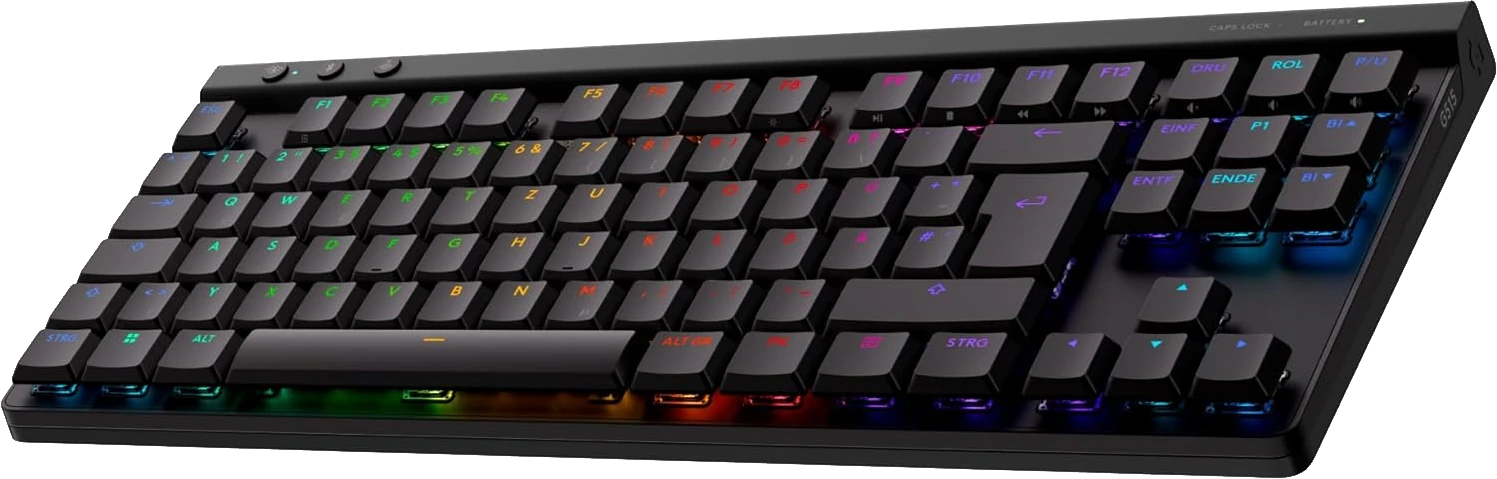
I take my keyboard to coffee shops and other “outside” locations a lot. The “TKL” layout (tenkeyless: no number pad) makes my mouse and mouse pad fit perfectly next to the keyboard, without the space becoming too cramped. The geometry between my hands (left hand on WASD, right hand on mouse) and the screen stays relatively symmetrical, which is nice. I don’t type so many numbers anyway, so not having a number pad is no big loss for me.
In contrast to more compact layouts, I prefer “TKL” (also known as 80% layout) so I don’t lose my muscle memory for the cursor and navigation keys (and Delete, Insert) from proper standard-layout keyboards. Because at home, on a bigger desk, or on public consoles, I might still want or need to use traditional full-size keyboards. TKL allows to ease the transition between full and compact size.
I set the backlight to a dim single color (brownish orange) and use it in Bluetooth mode. Please don’t wardrive me, but I want to believe that the encryption key in modern Bluetooth 5.2 standard, created once during pairing (which I’ve done safely at home), provides sufficient security against casual eavesdropping.
The keyboard has a little holder for the proprietary dongle, which is convenient when I want to attach the keyboard to other devices without going through the trouble of pairing it first.
The keyboard backlight profile (again, single color) can be saved as the default profile on the device (inside the firmware chip), so that I don’t need to keep any Logitech software installed. Finding the button to save this profile in hardware was a bit tricky (and I forgot where it was), but it’s there, trust me. The keyboard has a little on/off toggle in the top-right corner. When turning it on, I never see any rainbow RGB, I see my custom-set color right away.
The keyboard charges over USB-C with the same charger that I use for my USB-PD-enabled laptop, so that’s neat. I charge maybe once a month.
Laptop stand: Nillkin Versatile Laptop Sleeve
I’ve been using this for many years in both its 15.6″ and 14″ size. I don’t understand how anyone can use a laptop “on the go” without this stand.
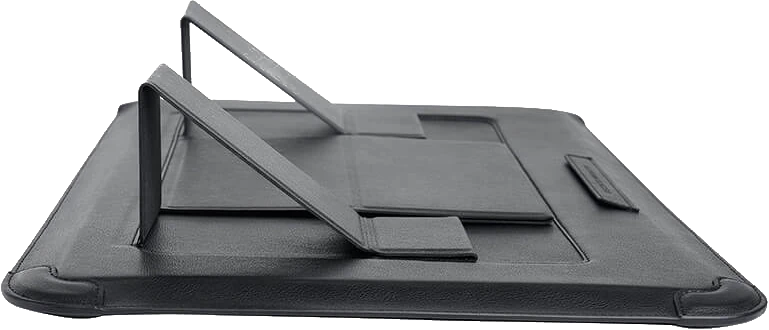
When I bring my external keyboard, I use the middle flap to lift the screen even higher. Without keyboard, I use the outer two flaps, as the middle flap would make the wrist angle too awkward when typing on the laptop.
The product design is pretty much perfect. It does not require any magnets, hinges or mechanical parts. It’s simply folding pieces of synthetic leather (PU leather), durable and firm. Lasts literally forever.
Mousepad
Along with my combo of TKL keyboard, laptop and laptop stand, I use a relatively small mousepad. I used to use a cheap one made of cloth for long time but recently upgraded to one made of hard plastic, that has a kind-of-leather surface on the bottom (to prevent slipping) and a hard flat surface on the top. On a flat table, it does not feel better than a cloth mousepad, but the rigidity of a hard mousepad means that you still have a flat mouse surface in uneven conditions, for example on a bed, sofa or when the mousepad flap of your laptop stand is not 100% flat anymore.

I got my current mousepad in China for a pretty low price from an unbranded seller, the same mousepad was also available in Taiwan from a different vendor. I can’t find any similar mousepad in Europe. Public brands like Logitech and SteelSeries also have hard-surface mousepads, but they are usually too large for my taste, because they are optimized for gaming, not for digital nomad work/life.
Comments, questions?
And this is all the gear I have. What do you think about it? Do you want to get into photography? What gear are you using? Contact me if you have any comments or questions.
The text of this article is licensed under CC BY.